Westland Post
Our Chemical HeartsWestland Post is the school newspaper organized by Alistair Hink and shaped by successive student editors. Its work follows a regular four-issue annual schedule, but the paper is more than a routine record of school events: its themes expose a contest between approved school optimism and the students’ appetite for less conventional ideas. When a production crisis threatens its final issue, the newspaper’s continuity depends on its editors, designer, writers, and supporters turning a stalled process into a collective effort.
Editorial Identity and Structure
Alistair Hink runs and organizes Westland Post. His commitment to English and the arts also informs his teaching: after a math class ran five minutes late and cut into an English lesson, he called the math teacher to argue that the arts were no less valuable than mathematics. His seriousness about language helped draw Henry Isaac Page toward writing and, in turn, the newspaper. Henry had volunteered there since sophomore year, hoping eventually to become editor, and describes a natural sensitivity to grammar as one of the abilities that brought him to Hink’s attention.
Editorial leadership becomes a shared responsibility. Hink offers Grace Town the editor position, but she turns it down; Henry, angered by the decision, goes after her. Later, he explains that he and Grace will preside over the paper together. Their final issue is scheduled for the summer after both have graduated, making it a prospective legacy for the next group of seniors. The newspaper’s schedule therefore links short-term production work to a longer handover between student generations.
Each school year brings four issues, one released at the start of each term. The issue in circulation when Henry describes the schedule is the last one assembled by the previous editor, Kyle. The cycle gives Westland Post a defined rhythm: each edition must recap important events from its term while also sustaining a distinct thematic identity. The summer issue that Henry and Grace oversee is presented as the final installment of their own editorial tenure, not simply another deadline.
Themes and Editorial Culture
The paper’s themes are a visible point of disagreement between adult expectations and student taste. The usual options are upbeat, familiar subjects such as “Friendship!”, “Journeys!”, “Acceptance!”, and “Harmony!” Teachers favor material that reinforces the idea that teenage years are the best of life, while students welcome subjects that depart from that formula. The contrast concerns not only what the paper covers, but what kind of publication it is permitted to be: a reassuring school newsletter or a space for less predictable editorial choices.
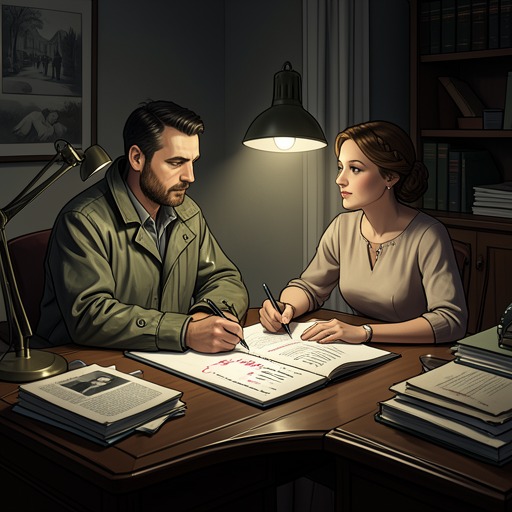
Kyle had pushed against conventional themes with abstractions such as “circles,” “red,” “uncanny,” and “faded.” His choices were frowned upon by teachers but popular with students; at least 45 percent of them picked up his papers, which Henry regards as an unusually strong readership for a school publication. Kyle’s success raises the standard Henry and Grace hope to surpass. In pursuit of what Henry calls a perfect theme, they hold regular after-school planning sessions, working side by side at their desks and filling in the newspaper’s pagination with ideas. Early possibilities include “New beginnings,” “Fresh starts,” “Becoming the person you’re meant to be,” and “Forever young,” all of which they find inadequate.
Hink gives the editors broad freedom over content, trusting them to observe the newspaper’s charter. He meets with them only once to plan, leaving the actual brainstorming and development of the issue to the students. That latitude makes their creative responsibility substantial: they must find a theme, assemble enough material to fill the paper, and coordinate a design that can go to print. Their search for a defining idea is therefore also a production requirement, not an abstract debate.
Deadlines and Production Pressure
The newspaper relies on coordination between editorial work and design. Lola Leung is responsible for the design, and without an agreed theme and sufficient content she cannot complete it on time. As Henry and Grace miss or reschedule meetings Hink has arranged to discuss the paper, he warns that the lack of progress is becoming serious. He gives them until the end of the month to get the issue under control, or he will replace them as editor. The warning makes clear that editorial authority is conditional on delivering a finished publication.
The delay eventually leaves almost no time for ordinary production. Lola tells Henry that three months’ worth of design cannot be completed in a couple of days, even if additional articles arrive. The deadline is fixed: the paper is due to go to print on Monday, and the printing has already been paid for. Lola says that in thirty-five years Westland Post has never failed to go to print and insists Henry will not be the exception. Although she says she would fire him immediately if the decision were hers, Hink still has faith that he can assemble something in time. Henry is excused from class for the rest of the day and ordered to gather the writers in the newspaper office and finish the paper.
The Redemption Issue
The emergency response turns the editorial problem into a group effort. Fourteen people are brought in to do three months of work in two days. Sadie Page helps lay out snacks promised in a Facebook post, while Lola and Henry take their places on the office couch and the others sit on the floor with Kit Kats and Mountain Dew. The improvised gathering supplies a working setting and a small promised reward, but it does not erase the compressed timetable or the unfinished work.
Henry announces that the theme will be “redemption,” the subject he had previewed in his post. The suggestion meets immediate skepticism: Suki Perkins-Mugnai asks whether it means The Shawshank Redemption, and Murray Finch dismisses it as a poor theme, still favoring “species dysmorphia.” Their reactions preserve the newspaper’s characteristic tension between a chosen editorial direction and the irreverent alternatives offered by its contributors. The evidence establishes the theme and the effort to meet the print deadline; the rescue begins not with effortless agreement, but with a crowded office, a defined deadline, and a team expected to make the issue work.
Institutional Significance
Westland Post joins recurring school coverage to a student-run argument about what school life can mean. Its regular schedule and thirty-five-year record give it institutional continuity, while its changing editors and themes allow each group of students to leave a distinct mark. The popularity of Kyle’s unconventional issues shows that the students’ audience is not limited to the safest subjects, even as teachers prefer a more reassuring editorial tone.
The production crisis reveals how dependent that independence is on practical cooperation. Hink’s trust gives Henry and Grace latitude, but the missed meetings threaten Lola’s design work and put the issue’s publication at risk. The demand to print on Monday ultimately gathers the writers around a shared task. In this way, the redemption theme is also the name of the attempted recovery of the newspaper’s work: an ambitious editorial project must be rebuilt under pressure, through the combined labor of the people who make the paper.